Hank Tyler’s Statement
Chippy Chase
Chippy Chase had a great influence on my interests and lifelong sculptor of birds. I was very fortunate to have grown up within several miles of Chippy’s home on Merepoint, and known him for over forty years.
1950s and Camp Chewonki
I first met Chippy in 1958, in the late spring, when my uncle Burt Whitman took me to Wiscasset on a birding trip. We met Chippy at the family mansion on High Street where his brother-in-law, Davis Pratt was visiting; and we walked down High Street to Chippy’s workshop at the back of a neighbor’s barn. Chippy was working on a Black Skimmer, and had a study skin loaned from the American Museum of Natural History as a reference. Later in the morning, we birded on Camp Chewonki’s property. After birding, Chippy made a point of stopping by Chewonki’s farm house to meet Chewonki’s founder, Clarence Allen.
In 1918, Chippy’s mother rowed 10 year old Chippy to Clarence Allen’s new boys camp on Chewonki Neck on the Sheepscot River – thus becoming the first camper to arrive. Chippy had a lifelong relationship with Chewonki. He would attend summer time bond fires to tell stories and Maine saltwater lore. Chippy’s favorite story to tell was of digging clams at high tide with a long auger-like devise. Chippy developed a live-long friendship with Roger Tory Peterson in the 1930 when Roger was a young instructor at Chewonki. On a number of occasions Chippy when out of his way to introduce me to Roger at “Birds in Art” annual exhibitions – by the 1990s Roger knew who I was.
In the 1962, after selling the large Chase Seafaring Homestead in Wiscassett, Chippy and his sister Judy purchased land on Montsweag Road in the small town of Woolwich west of Wiscassett – Judy a house for the summer, and Chippy land where he built a simple building for his workshop that he used for about 35 years.
1960s
The “art-scene” in the early 1960s in the Wiscasset to Brunswick area was quite limited and thin. The famous sculptor, William Zorach along with his daughter Dahlan Ipcar lived on Georgetown Island where French sculptor, Gaston Lachaise, had a studio in the 1930. Avant-Gard artist Mildred Burrage (1890 – 1983) lived in Wiscasset and she was instrumental in establishing the summertime Maine Art Gallery in Wiscasset. Burrage was an internationally known artist from Portland. Marine artist, Rick Hasenfus,(1932 -2019), also from Georgetown Island was active in the 1960 to 2019, Silversmith, Clifford Russell lived and worked in Woolwich, while painter John Folinsbee, (1890 – 1972), maintained a summer house at Murphy’s Corner on the Monstsweag Road. Folinsbee’s two daughters – Elizabeth married artist Peter Cook, and Elizabeth married Elmer Wiggens where they summer. Murphy’s Corner became a small artist’s center very close to Chippy’s workshop. Chippy delighted in socializing with the Cooks and Wiggens, and picked up a number of artistic perspective and skills that he used in designing his sculptures.
In the early 1950s, landscape and marine painter Stephen Etnier had a summer home on High Head Island at the mouth of the Kennebec River in Georgetown. Later, Steve built a large modern home in Harpswell on a rocky promontory overlooking Casco Bay. Chippy knew all of these artists and they were part of his artistic circle of social friends. He picked up artistic perspectives from his social interactions – pleasant and informal artistic lessons.
Bob Phinney who lived on Arrowsic Island was a bird artist several years older than me who was indirectly influenced by Chippy. Bob learned silversmithing from Woolwich artist Clifford Russell, and Bob combined his skill of painted bird carving and silversmithing into unique bird sculptures. Bob was also duck hunter, and hunted Black Ducks in nearby saltmarshes on the Sheepscot and Kennebec Rivers. Bob would often show his painted wood carving of birds to Chippy, and waiting for Chippy’s comments. Chippy was not a fan of painted birds, but did purchase one of Bob’s early carvings of a crow and spider in silver.e
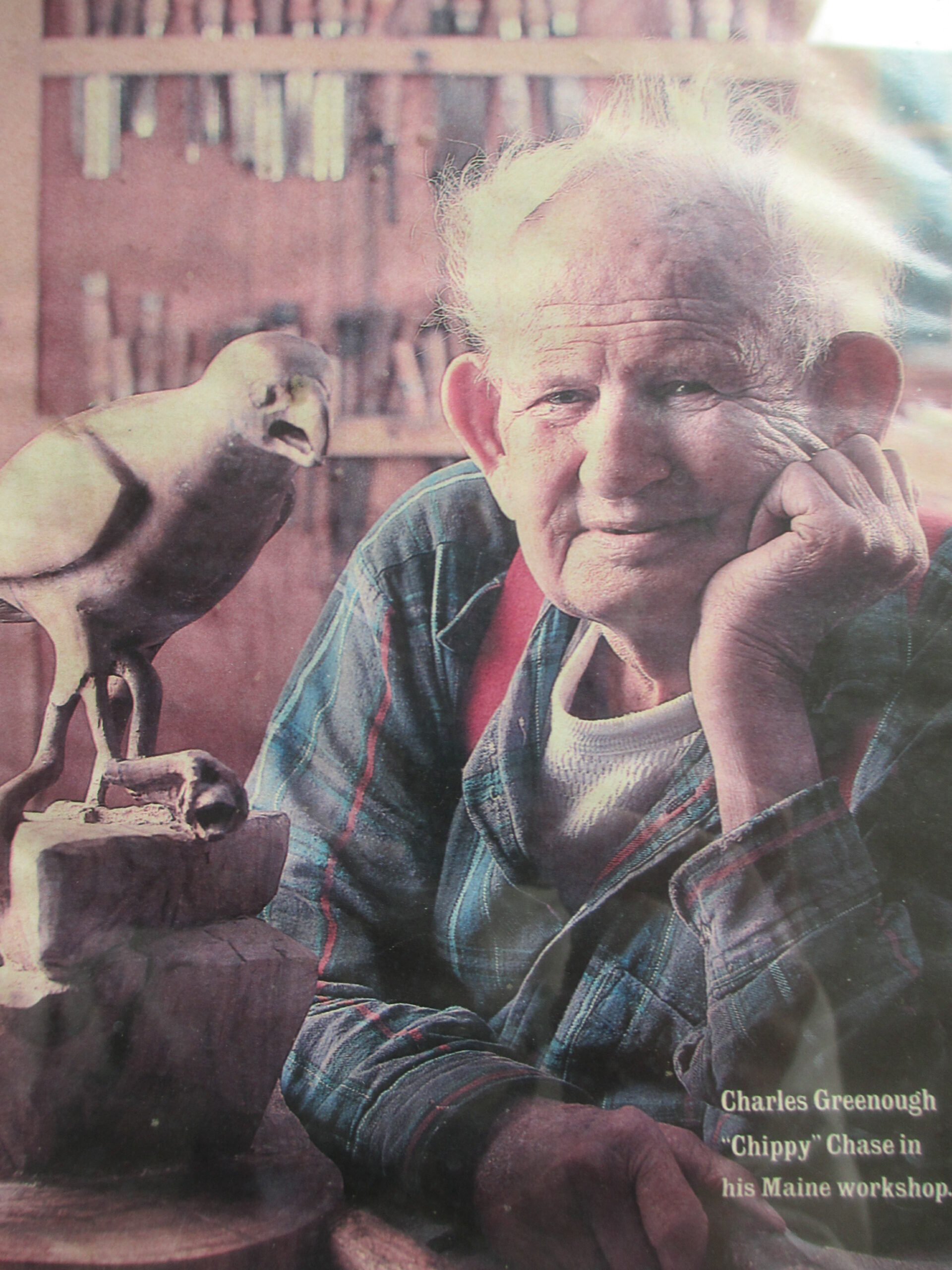
Chippy Chase in Workshop
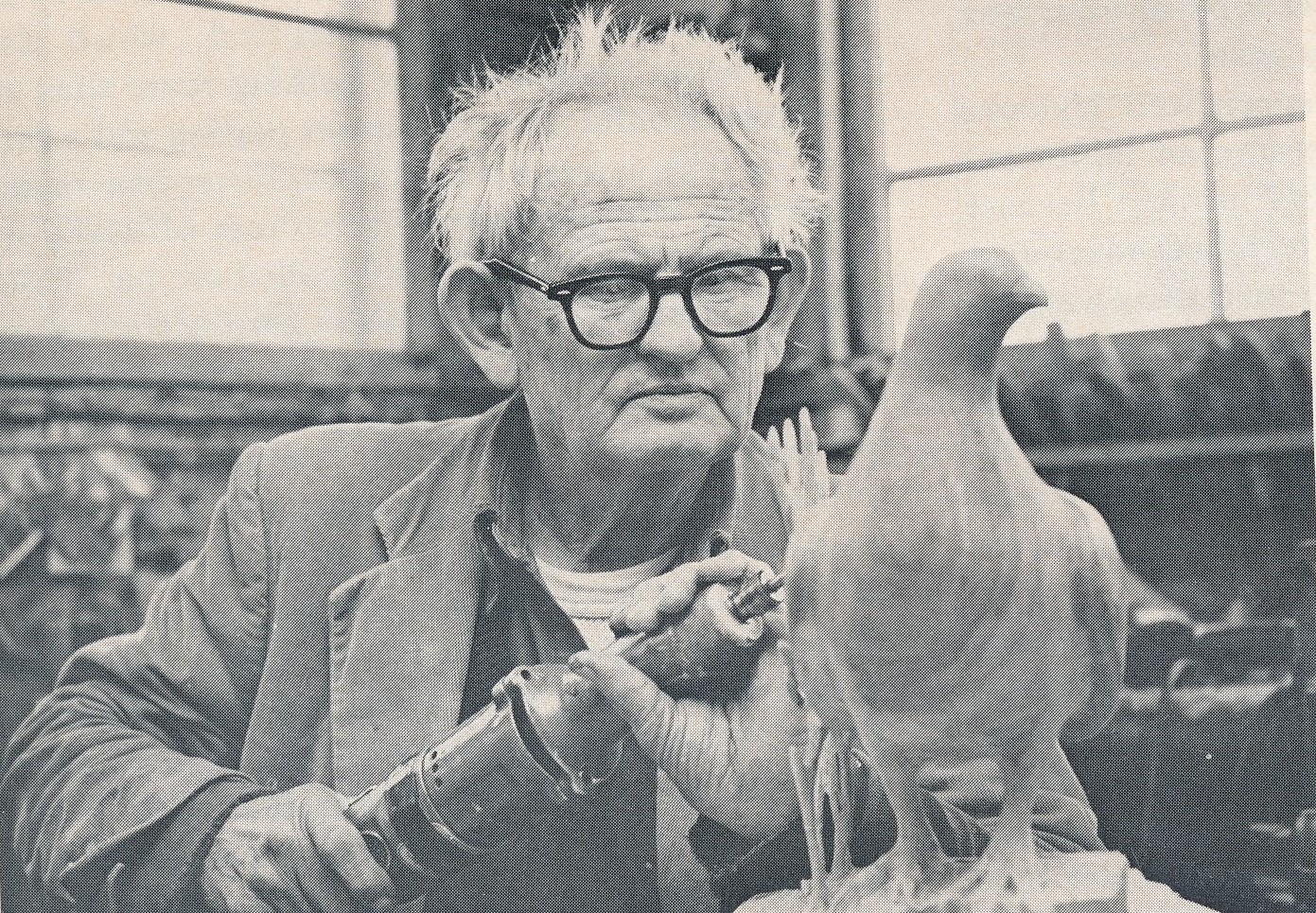
Chippy Chase working on Ptarmigan sculpture
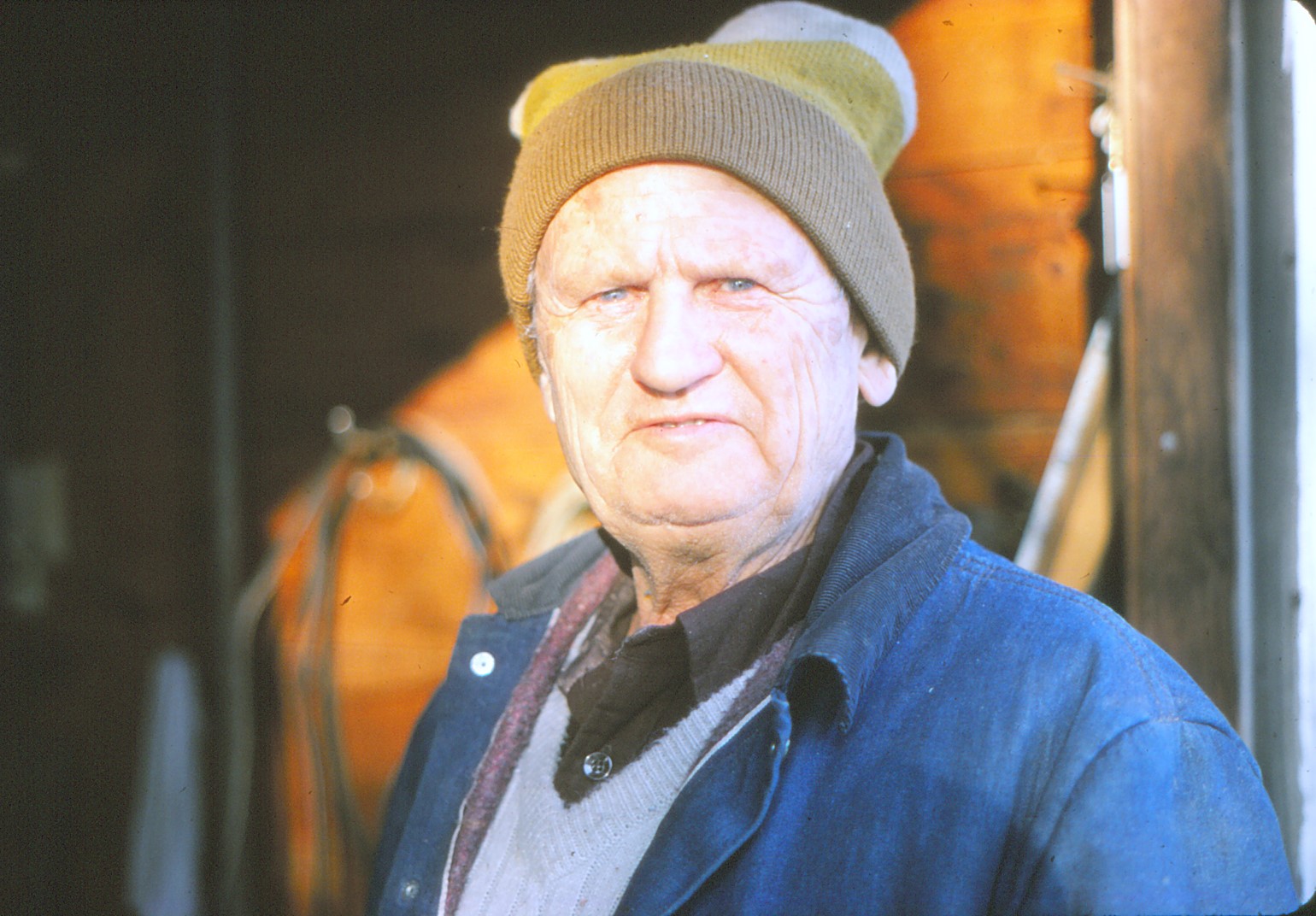
Chippy Chase, 1982, Hank Tyler photo
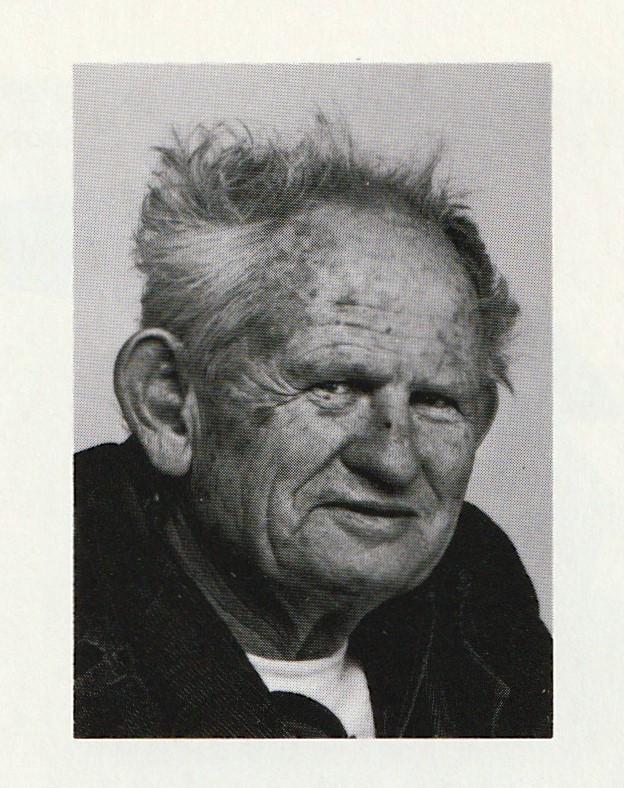
Chippy Chase, Birds in Art catalogue, 1984
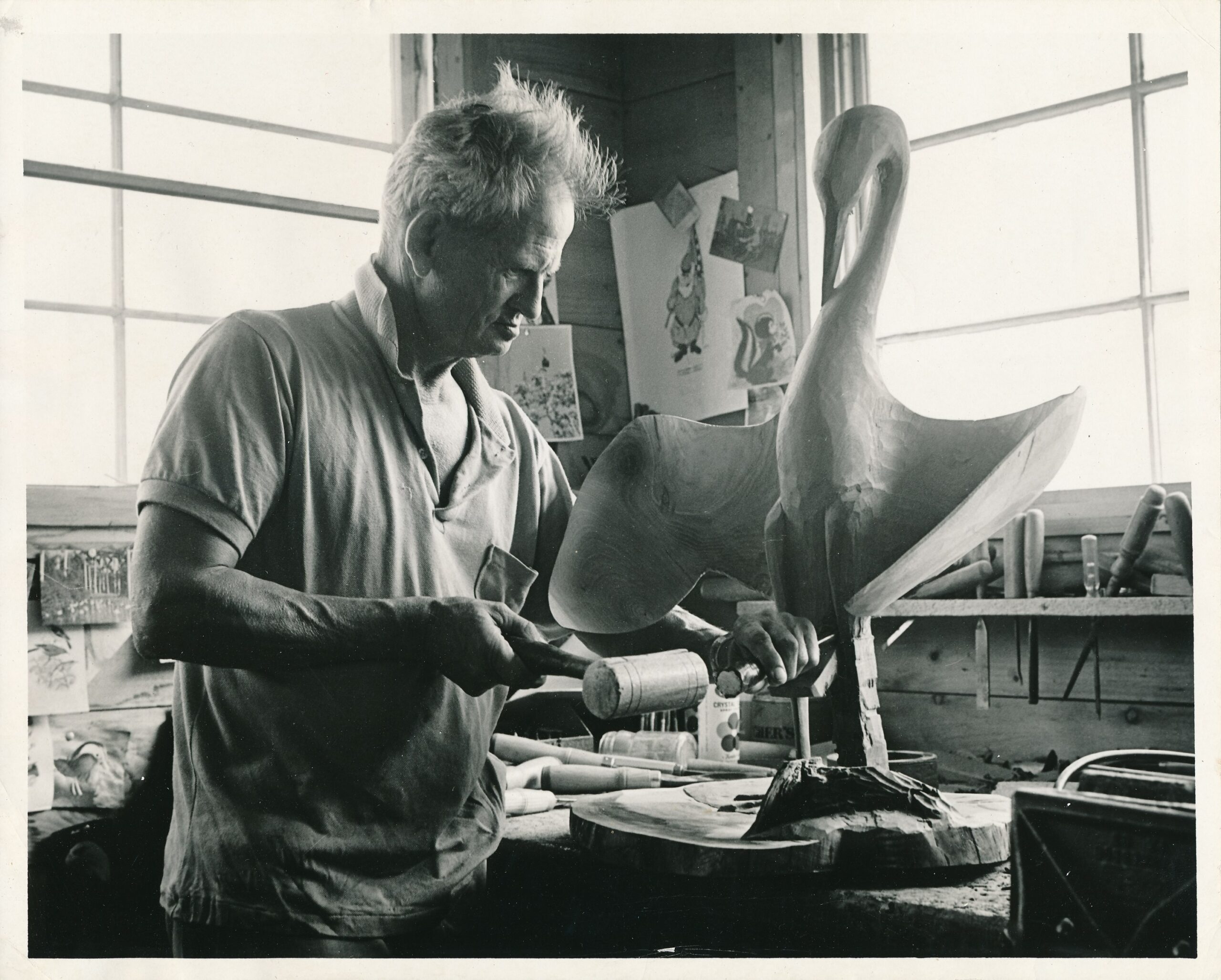
Chippy Chase working on Galiath Heron, #251, 1967
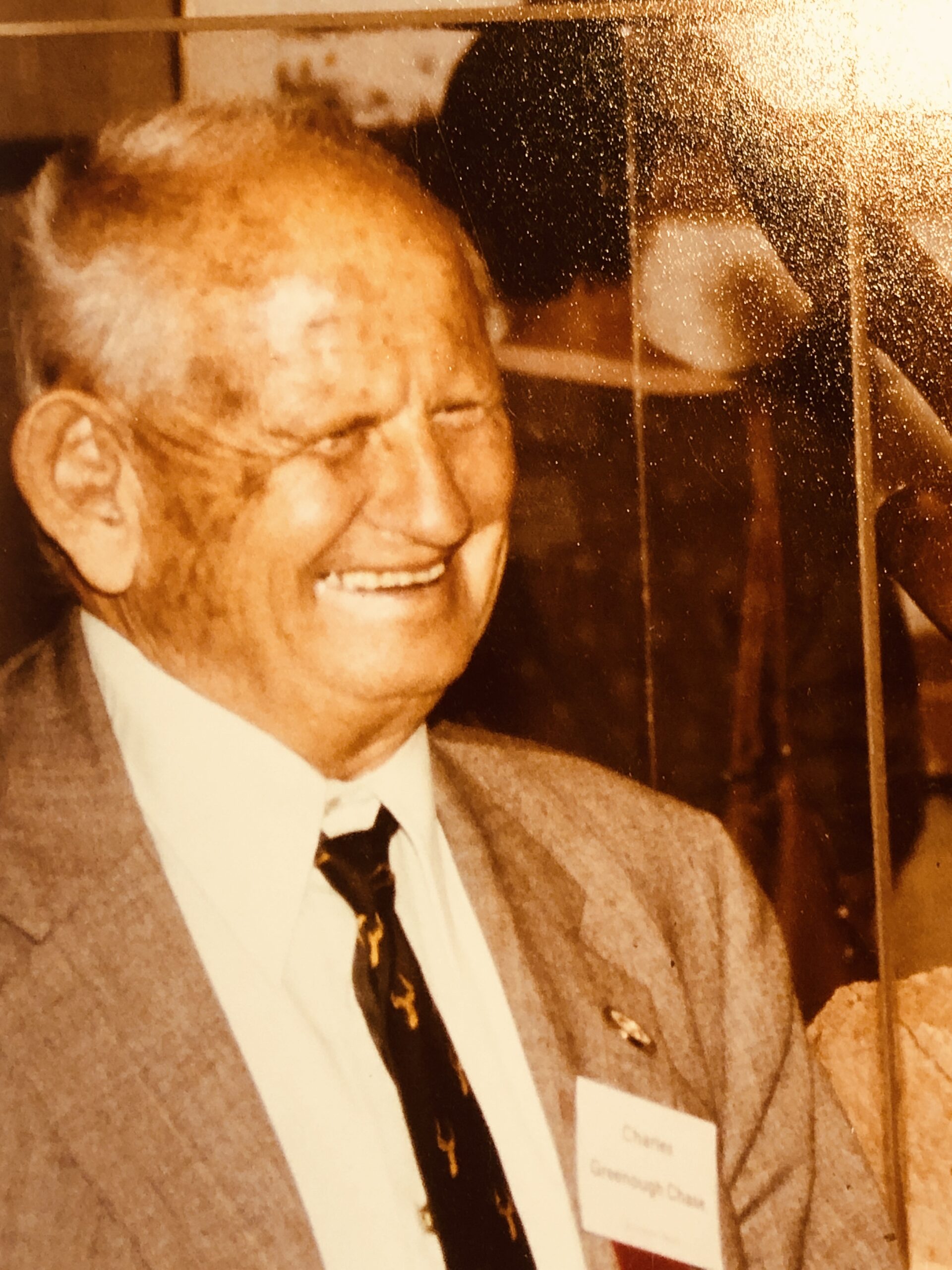
Chippy Chase, Birds in Art
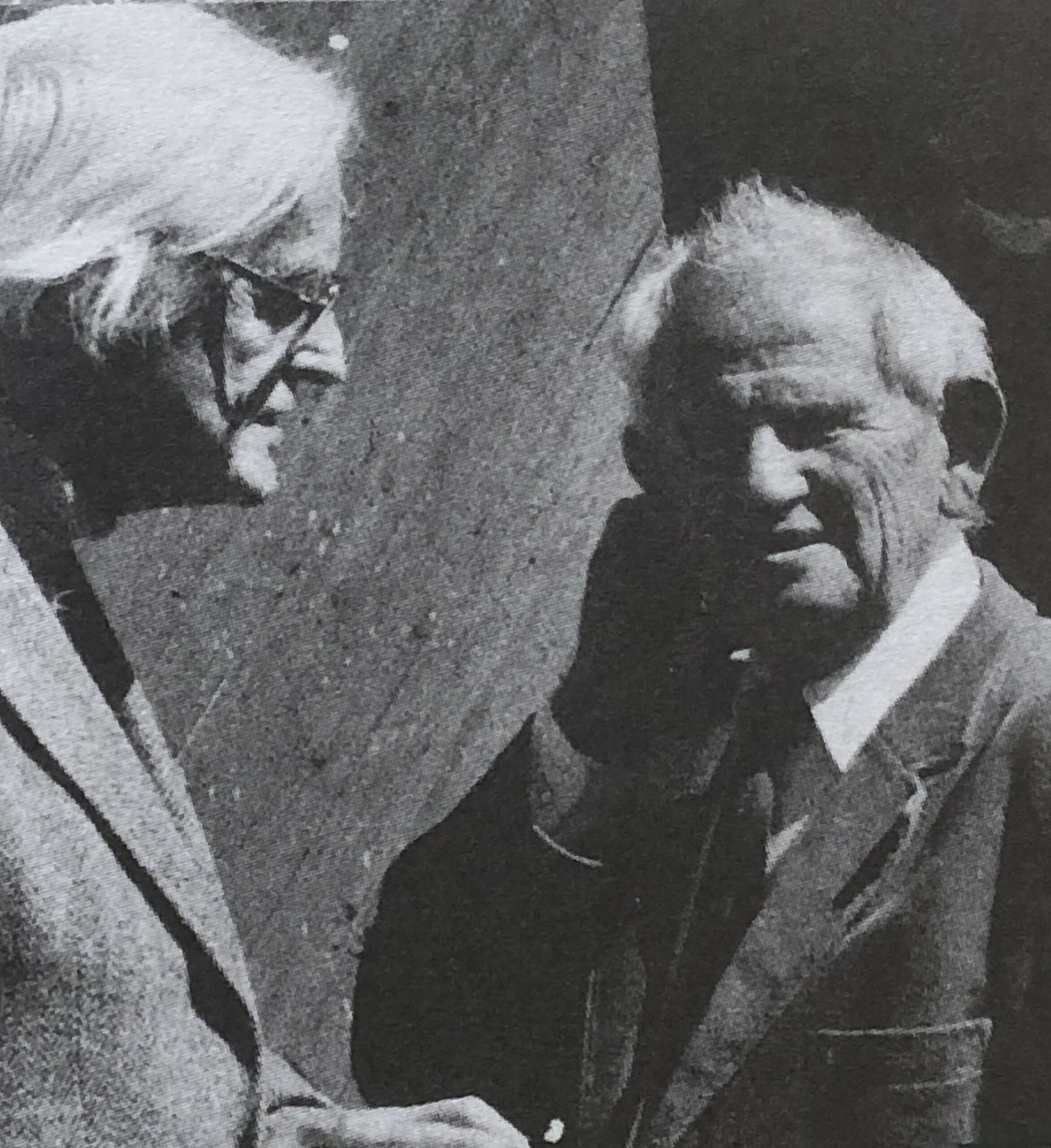
Chippy Chase and Roger Tory Peterson
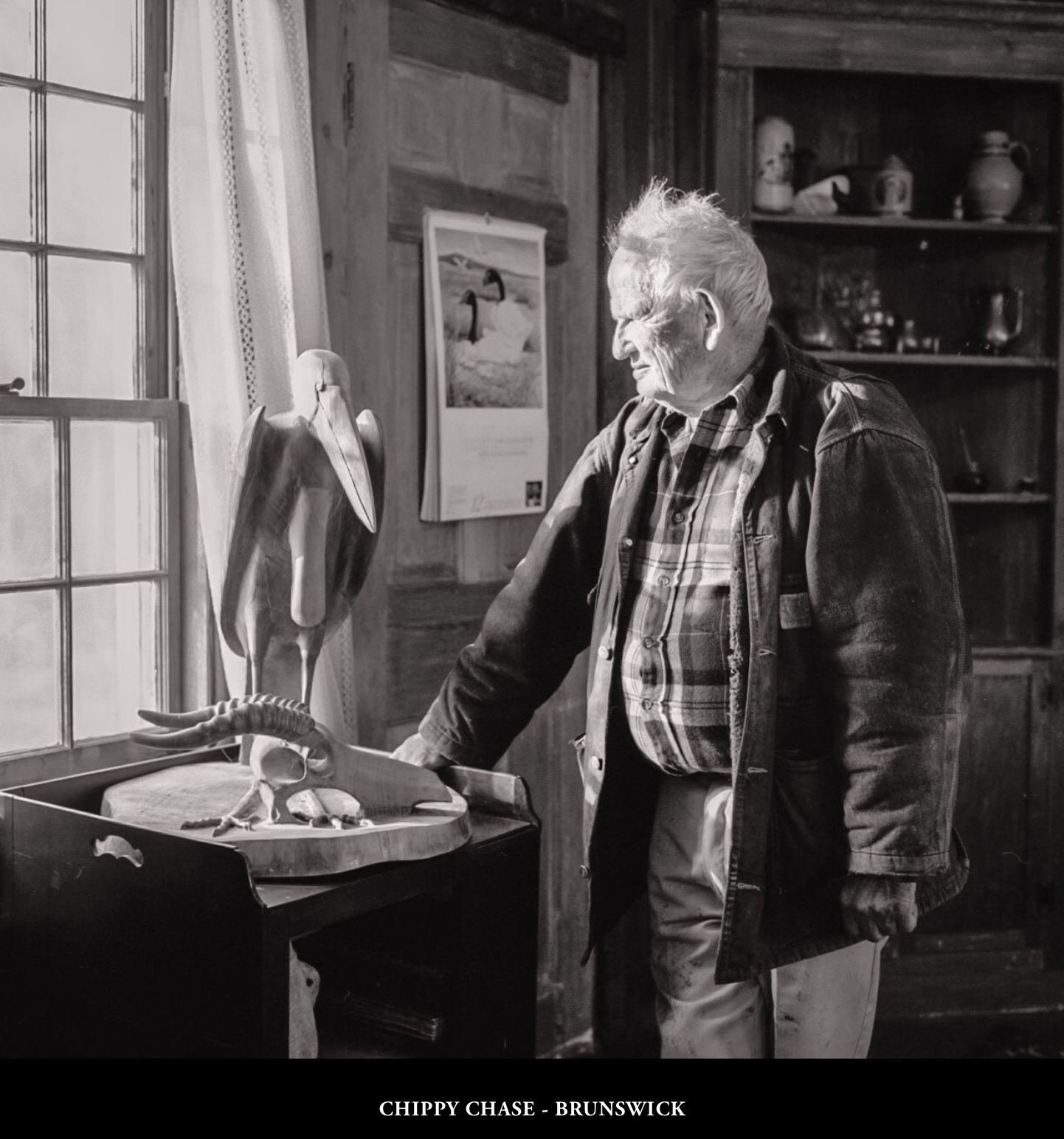
Chippy Chase with Maribou Stork, #368, 1990
Merepoint, Brunswick
Our family moved into our newly built house on Merepoint in January 1955 next to my uncle’s house, Burt and Bibbo Whitman. In 1958, Chippy and his wife Georgie moved into the Spinney house on Merepoint Road that they bought about two miles from the Tyler-Whitman’s houses.
I recall Chippy saying that he was glad to move into a smaller house in the country because the family home, a very large home built by his great-grandfather, was difficult to heat during Maine’s long cold winters. Chippy said during the winter he would hire a furnace man to shove coal all night long into the furnace in the basement.
For about 35 years Chippy drove from Brunswick to his workshop on Montsweag Road in Woolwich. Many people make the trip to Montsweag Road to visit Chippy and see the sculpture he was working on. The workshop building was simple with no running water, and only a small wood stove. As his workshop aged over the years it took on the Chippy Chase personality.
Chippy and Burt Whitman quickly developed a friendship that lasted forty years. They were roughly the same age and had mutual interests. Both were from Boston, both were birders, and both loved following the Red Sox. Burt’s father had been the sport’s editor for a major Boston newspaper, and was well known for reporting on Red Sox games.
Chippy loved his life in Maine, and often mention that he did not miss Boston. One year at Harvard Law School taught him that a live as a lawyer would mean probably a live of living in the city of Boston and working in an office. After one year of law school, Chippy left for the seaside country life of Wiscasset and surrounding coastal areas. Law school taught Chippy to use long, yellow leg-size writing paper – a tradition he used for his whole life.
My uncle Burt Whitman, a banker, several times would mention that Chippy was a very fortunate person to have family wealth so that he could do what he wanted in life. And, Chippy did enjoy living in Maine and following his passion for outdoor living while developing his own artistic career.
1960s
Chippy frequently visited the Whitman’s home for early morning birding in the spring time. When Chippy completed one of his sculptures he would bring it to the Whitman and Tyler homes to display. Discussions of the latest Red Sox game was fun times for Burt and Chippy.
In the late 1950s and throughout the 1960s when I was in high school and university, Chippy would bring his completed sculptures to the Whitman -Tyler home to display his latest bird sculpture.
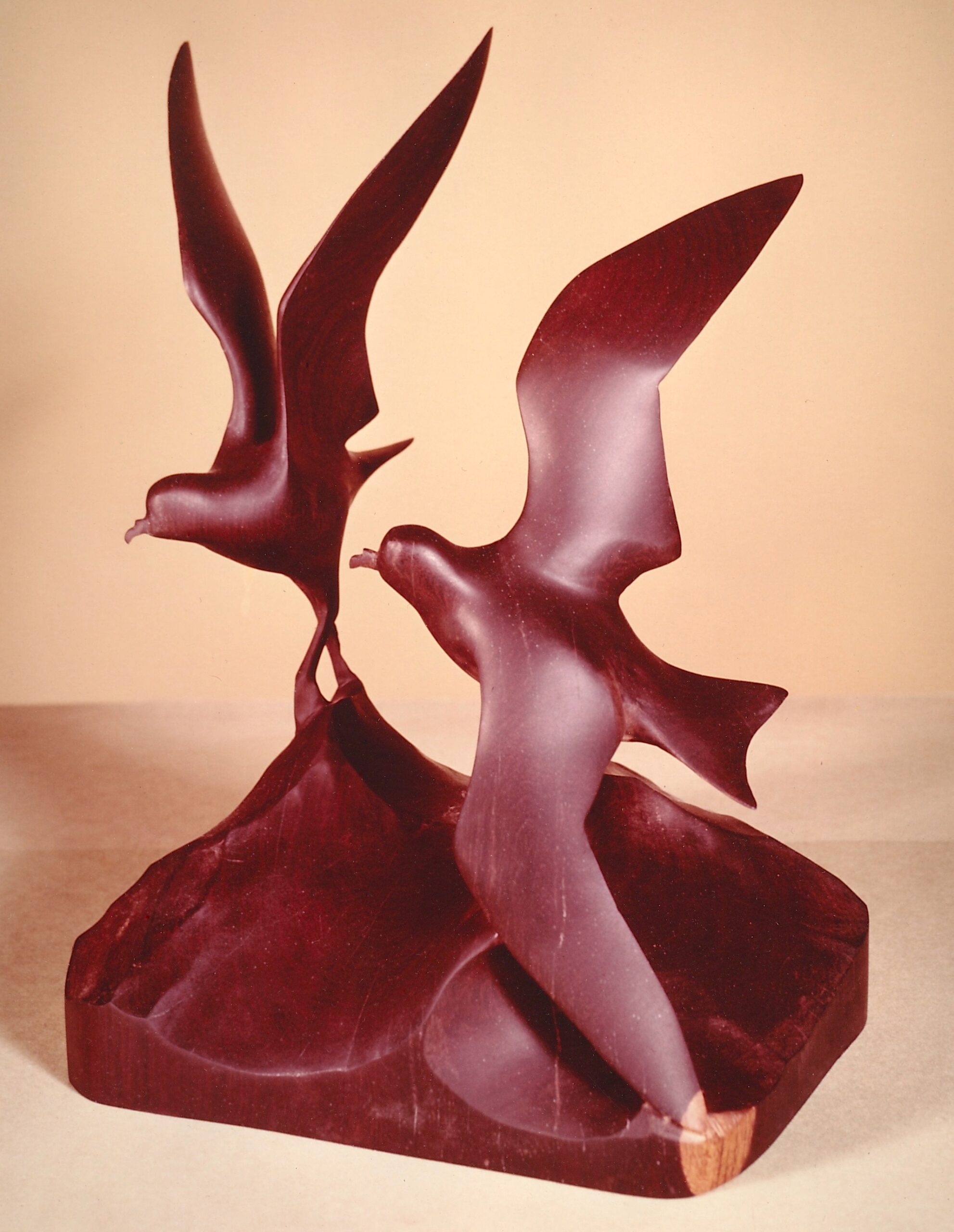
I have vivid memories of Chippy bringing the finished pair of petrels in ebony (#224) to our house in 1961. About the same time the Boston newspaper, Christian Science News, printed an art review of Chippy’s work with photo that I recall was of a cormorant, by the art critic Ms. Wilson.
In December 1960, Chippy’s wife, Georgie, purchased my third sculpture, a tern in white birch, as a Christmas present for Chippy.
Burt Whitman had a keen interest in birds – a Bowdoin College biology graduate. In the early 1930’s when in high school, or after graduation, he worked or studies at Dr. Oliver Austin’s bird study station on Cape Cod where he learn and practice bird banding. In the last, 1950 Chris Livesay and me, persuaded Burt to renew his bird banding license with the US Fish and Wildlife Service, and obtaining sub-banding licenses for Chris and me. A former chicken coop on the Whitman’s property was converted into the “Merepoint Ornithological Research Station” our bird banding office that we operated until 1963 during our high school years.
Chippy took a keen interest in our bird banding operation, and in the early 1960s obtained his own license and conducted his own bird banding at his new workshop on Monstsweag Road. Chippy organized his own birding and bird banding trips to Matinicus Rock in Penobscot Bay, and taking along campers and staff from Chewonki. When Chippy organized boat trips to Matinicus Rock from Tenants Harbor in Cushing, he sometimes stopped with his Chewonki campers to visit with Andy Wyeth.
Chippy had friends along the Maine coast, including Sherwood Cook, a lobsterman in Tenants Harbor and Andy Wyeth’s brother-in-law. During our high school bird banding days, Chippy arranged for Chris Livesay and me to join him on a bird banding trip in Penobscot Bay to Little Green Islands with Sherwood Cook in his lobster boat. The Cook family owned the Green Islands.
In my high school years 1960 -1963 we would often enjoy birding around Merepoint during the springtime migration. Sometimes, we would set up our mist nets to capture migrating birds, and Chippy would join in extricating birds from the nets, banding, and writing banding numbers and records.
During the height of spring migration in the last two weeks of May, either Chippy or Burt would drive me to high school so we could stop at the head of Maquoit Bay for shorebird birding. One time when Chippy was driving we had stopped along the Rossmere Road to bird when artist and Chippy’s good friend Steve Etnier stopped and the two had a long conversation – I was late to school that morning.
The early 1960s in Brunswick Chippy found himself with a distinguished and happy group of birders: Dr. Charles Huntington and Dr. Nathan Dane of Bowdoin College, along with Burt Whitman. I grew up with this circle of birders, that set my compass as a birder and bird sculptor.
Also, during high school Chippy hired me to work on the trail he developed to the southern tip of Miller’s Point cutting trees and clearing brush. Later, Chippy hired my younger brother Tim to do similar work.
During the winter of 1959-1960, I carved by first bird sculpture of a Long-tailed Duck in pine, and engraved in March 1960. My father was a salesman of woodworking equipment, and we had a well-stocked workbench and tools in our basement. During the previous several summers I had been making model sail boats in pine that we sailed in a nearby pond and in Maquoit Bay when we went swimming. Forming a symmetrical boat hull was easy for me – giving me an early glimpse of my ability to think in three dimension and easily make shapes.
In 1960 my father began bringing Brazilian Rosewood logs from the Tebbetts woodworking plant in Locke Mills, and giving them to Chippy. My second bird sculpture was a Ruddy Duck in Brazilian Rosewood that Pat Livesay bought for $22. Chippy gave me small pieces of wood for sculpting: Bermuda Cedar for Pintail Duck, #4; Ebony for Leach’s-storm Petrel, #5; Black Walnut for Black Terns #7 and #8.
Chippy took an interest in my beginning wood sculptures and encouraged me to continue. Burt Whitman took me to his new workshop on Montsweag Road in Woolwich. When Chippy brough his newly completed sculptures to the Whitman’s and Tyler’s home, I was treated to seeing these new sculptures and listening to Chippy’s comments. I was young and impressionable so these experiences obviously made a strong impression. His teaching approach was to encourage and provide instructive comments. I never worked alongside Chippy in his studio, although I visited his workshop in Wiscasset and Montsweag Road in Woolwich.
Family friends in Brunswick supported my budding bird sculpting by purchasing my sculptures. I remember my parents, commenting that people who could not afford Chippy’s sculptures, could afford mine, and like supporting a young artist.
One memorable birding and art trip was going to Matinicus Rock in July for birding and bird banding. Chippy invited Andy and Betsy to join our expedition. There was interesting observations and discussion of birding and art on this trip. Both my mother and Andy separately painted Matinicus Rock Lighthouse.
Chippy encouraged me to view his 16mm movie photos for Florida birds, and I spent some time in Chippy’s basement watching his films. He also introduced me to his in-laws Herb and Pat Pratt of Cambridge, Massachusetts who had a summer home in Prouts Neck in Scarborough. During my high school summers Chippy would take me to Prouts Neck for birding around Scarborough Marsh, and then visiting with Herb and Pat.
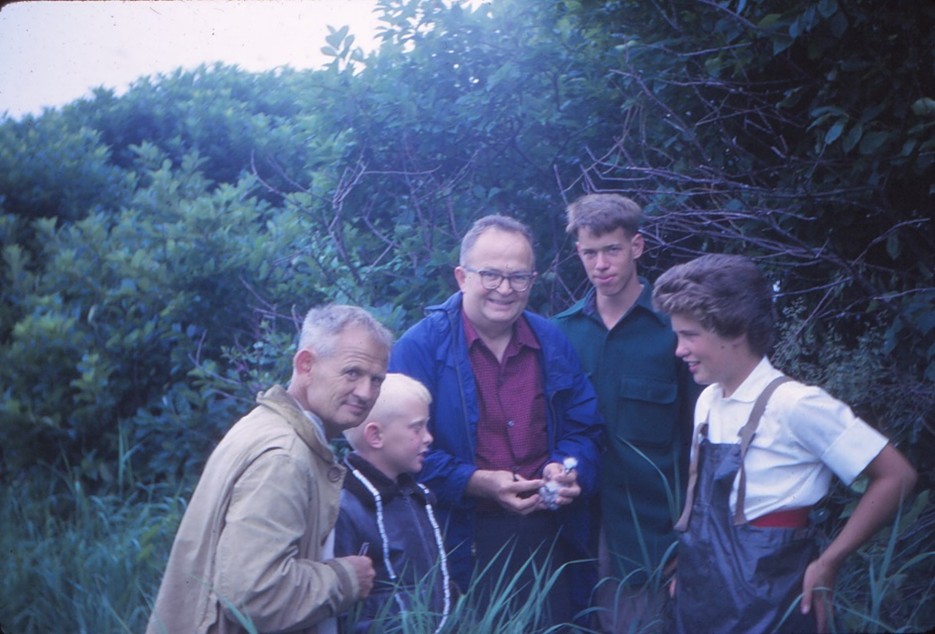
During the summer of 1963, Chippy asked me to go with him to the Portland Jetport where he began his first trip to east Africa, and then drive his jeep back to Merepoint. In August, he invited me to join him sailing with his father-in-law, Mortimer Pratt and brother-in-law, Stuart Pratt, sailing from Prouts Neck to Boothbay Harbor, spending the night anchored between Allen ad Benner Islands. During this cruise, Chipping make sketches of the birds spotted in the sailboat’s log. Stuart Pratt has the log books and verified Chippy’s bird sketching.
When in high school my mother, a gifted watercolor artist, was active in the Harpswell Garden Club summertime art show. I exhibited my sculptures at one of their art shows, and met the famous sculptor William Zorach, a summer resident of Georgetown Island, and a friend of Chippy’s. Zorach complimented my sculpture asking me how I dealt with cracks in the wood. Zorach commented that he “boiled the wood in oil before beginning his sculptures.”
During my university days at the University of New Hampshire, I would show Chippy my recent sculptures. I am sure that I profited from seeing Chippy and paying attention to his comments.
After my university years I lived at my parent’s home on Merepoint Road, and frequently saw Chippy. We were able to acquire a large amount of Bubinga wood from Tebbitts Mill that was stored at Chippy’s Montsweag workshop. During this period Chippy was very supportive of my sculpting activities. He introduced me to Tom Crotty of Freeport and his Frost Gully Art Gallery where I displayed and sold a number of my sculptures. Chippy called his friend Wendell Hadlock, director of the Farnsworth Library and Art Museum in Rockland, and arranged for me to have an exhibition in June 1971. In 1970, I helped found the Merrymeeting Audubon Society, and Chippy became supportive of birding and environmental organization.
1970s and 1980s
Chippy loved the outdoors that he experienced as a boy and young man around Wiscasset. Hunting for ducks, pheasants, partridge, and woodcock. In the 1970s he would occasionally go hunting with longtime friends Bill Vaughan from Hallowell. Spring time was catching migrating smelts in Miller’s Creek on his property. Chippy acquired a Boston Whaler that he kept at New Meadows River cross from the New Meadows Inn. Chippy delighted in taking friends out blue fishing in eastern Casco Bay.
In 1972, Chippy hosted a National Audubon speaker at a Merrymeeting Audubon meeting in Bath, and after the program suggest that some of his friends go to the New Meadows Inn for drinks. It was at this event that Chippy introduced me to D.D. McAbee in the Allaquippa room of the New Meadows Inn – my future wife.
The New Meadows Inn was a fixture in Chippy’s life – for decades Chippy had lunch at the Inn, and frequently entertained friends, family and guest there. Dick and Doris Armstrong, the owners became good friends with Chippy. For years, Chippy would gift laminated photos of his bird sculptures. Dick Armstrong accumulated so many sculpture photos that he decorated a wall in the Inn with Chippy’s photos, that was referred to as the Chase Memorial.
From 1972 to 1974, D.D. and I had an 18 month backpacking adventure in Australia, New Zealand and Asia.
When D.D. and I returned to Maine as a married couple in 1974, Chippy and his wife Dodie loan us the use of Dodie’s house on Westport Island that turned into a three year rental.
Chippy was always happy and smiling and enjoyed engaging you in conversation. He took the time to take me along with others birding to several coastal islands, fishing for smelts in Millers Creek on his property, and bluefish fishing in Casco Bay.
In 1975, we joined many friends to celebrate Chippy’s 75th birthday that Dodie has organized. The special event of the party was a hot air balloon ride for Chippy that took him away from the party.
Chippy was always open for fun outdoor experiences. In the mid-1970s the water temperature of Maquoit Bay was warm enough to support hard shell clams known as quahogs. One summer late afternoon during an especially low tide Chippy joined D.D, me and others digging quahogs – another fun experience.
During the 1980s and 1990s, I would see Chippy infrequently in Brunswick or at his workshop in Montsweag Road.
“Birds in Art”
In September 1984, D.D. and I along with Herb and Pat Pratt attended joined the “Birds in Art” festivities at the Leigh Yawkey Art Museum in Wisconsin where Chippy received Master Wildlife Artist award. Chippy had encouraged me to submit to the juried “Birds in Art” Exhibition. This was my first time to be juried into “Birds in Art.” Attending and participating in the annual “Birds in Art” festivities was an event Chippy looked forward to and completely enjoyed every moment – 14 years from 1984 to 1997 as a Master Artist. I joined Chippy for eight different ‘Bird in Art” openings. I had an enjoyable time with Chippy at Birds in Art in Wausau, Wisconsin where Chippy would introduce me to well-known bird artists as he enjoyed the annual fun time of partying with artists from around the US and the world. He always made a point of involving me in talks with Roger Tory Peterson when recalled their Camp Chewonki Days. As a result, Peterson remembered me in connection with Chippy. As a Maine character, Chippy was often seen as the “life of the party.”
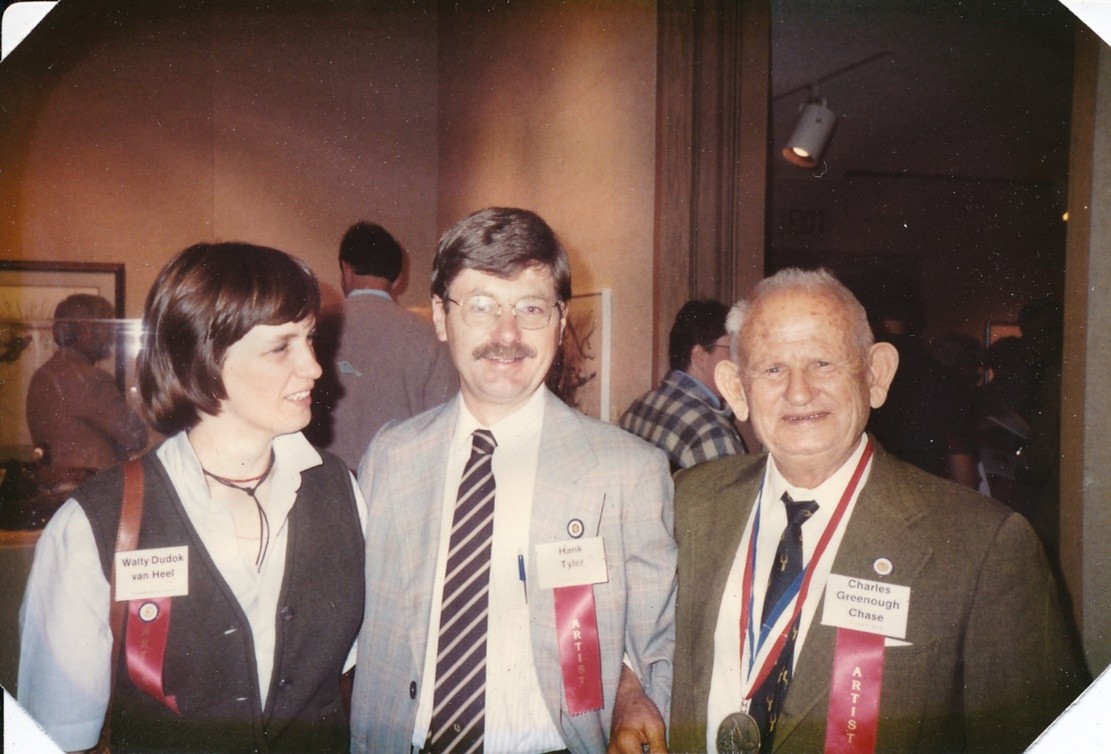
Chippy had an exciting life in the 70s and 80s. He live and eat well – cases of German Saint Pauli beer was always available at the Merepoint home, and his lunchtime meals at New Meadows Inn were plentiful. During this time he gained a significant pot-belly that caught up with him in the 1990s.
Chippy did not have students or teach classes. He reviewed bird carvings that a few carvers would bring to his Montsweag shop. In the early, 1960s he encouraged and supported my carving along with Bob Phinney. Chippy gave wood and commented on Montsweag Road resident Tim Ellis’s carving – but, Tim was full time director of Camp Chewonki, and had little time to pursue carving even as a hobby. Chippy mentioned that a women would stop by for instructions and help with her carving, and later committed suicide, and quickly pointed out that there was no connection.
I never took lessons from Chippy, nor asked him specific details on his technique. I observed and as a woodworker with a family workbench and tools followed by developing my own work patterns and artistic style. However, I did pick up a number of his approaches: natural finish, wood displaying attractive patterns, signing the bottoms of the sculptures, numbering each sculpture and keeping a list, and photographing all photos.
In the 1980s and 1990s I was too busy with a full time job and family life to visit Chippy often. In 1982 I visited his Montsweag shop with our children, Zach and Kate, in the spring time, and found Chippy working on his California Conder and a few photos were taken.
I would often stop by Chippy’s home on visits to Merepoint. One time in the late 1980s we found Chippy cutting firewood with his chainsaw, and commenting that he had just “nicked” his knee cap.
Chippy was a fixture in Maine, and it appeared that his life would continue forever. He kept himself physically and socially busy – attending Bowdoin College hockey games, an active member in the Brunswick Skating Club, going to Harvard Football games. Spring time was an enjoyable social time going to class reunions at St Paul’s and Harvard.
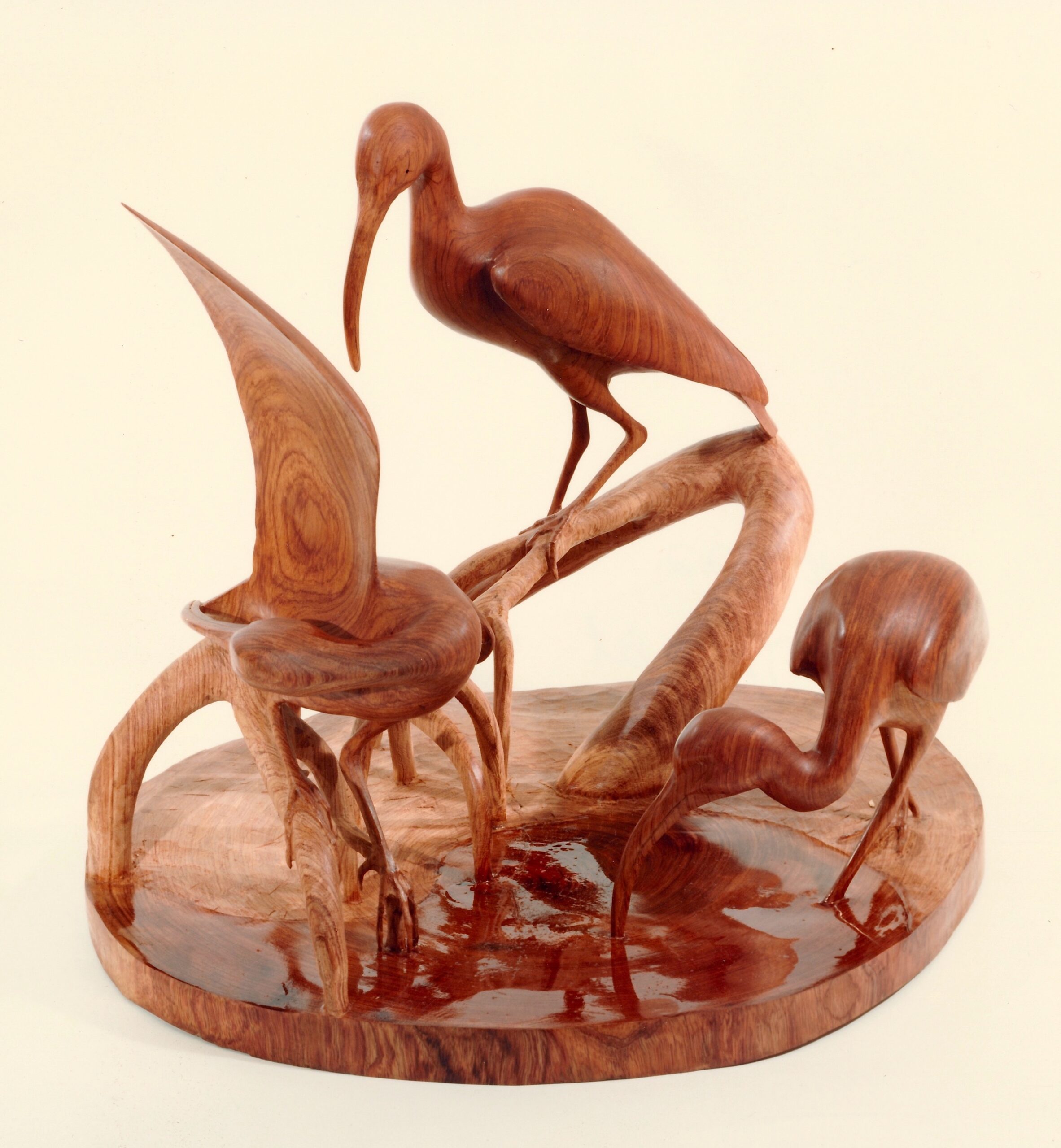
Around 1992, when he was about 84, had just completed rolling a large Bubinga wood log with the help of a crowbar from the barn to his garden workshop. This log would become sculpture #380 for Three Ibises.
Artistic Life and Artistic Style
Chippy honed his sculpting methods and artistic style over decades – he was self-taught. He began by whitling ducks, partridge and pheasants in small blocks of Mahogony in the 1930s. In the late 1930s when be lived in Wiscassett he devoted more time to his bird carvings. After WWI, his wife Betty encouraged his budding artistic career. Betty and probably his sister Judy worked to arrange an exhibition of Chippy’s sculptures at the Museum of Natural History in New York City in1949. Tragically, Betty and their infant son were killed in a plane crash just before this exhibition – Chippy never talked about this expedition.
From the beginning, Chippy’s style was using woods with colorful grain patterns, sanding them and then finishing the sculptures with a clear finish to show the wood’s grain and color – this was his style for his whole life.
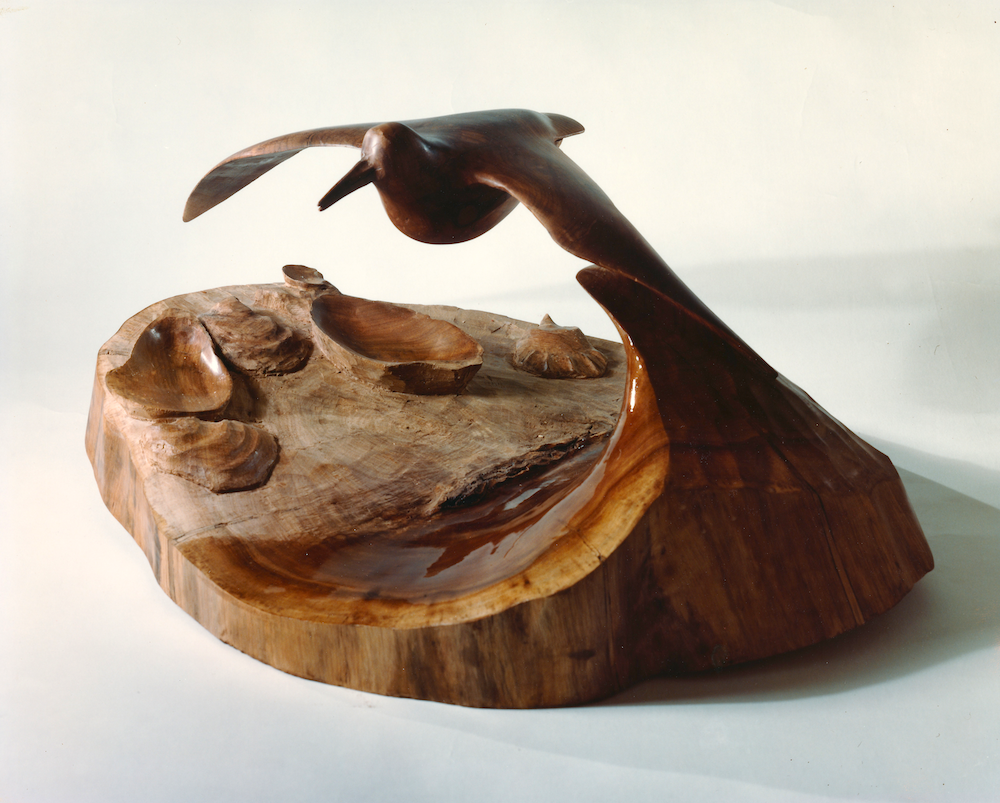
Time spent hunting, fishing, boating and birdwatching opened his view to habitat setting and plans that he could incorporate into his sculptures. I recall on a number of occasions birdwatching with Chippy, he would point out cat-tails, large leaves that could be incorporated into his sculptures. In the 1970s when he create a series of Oystercatcher sculptures he carved oystershells into the base. Cat-tails were use for structural support for many sculptures.
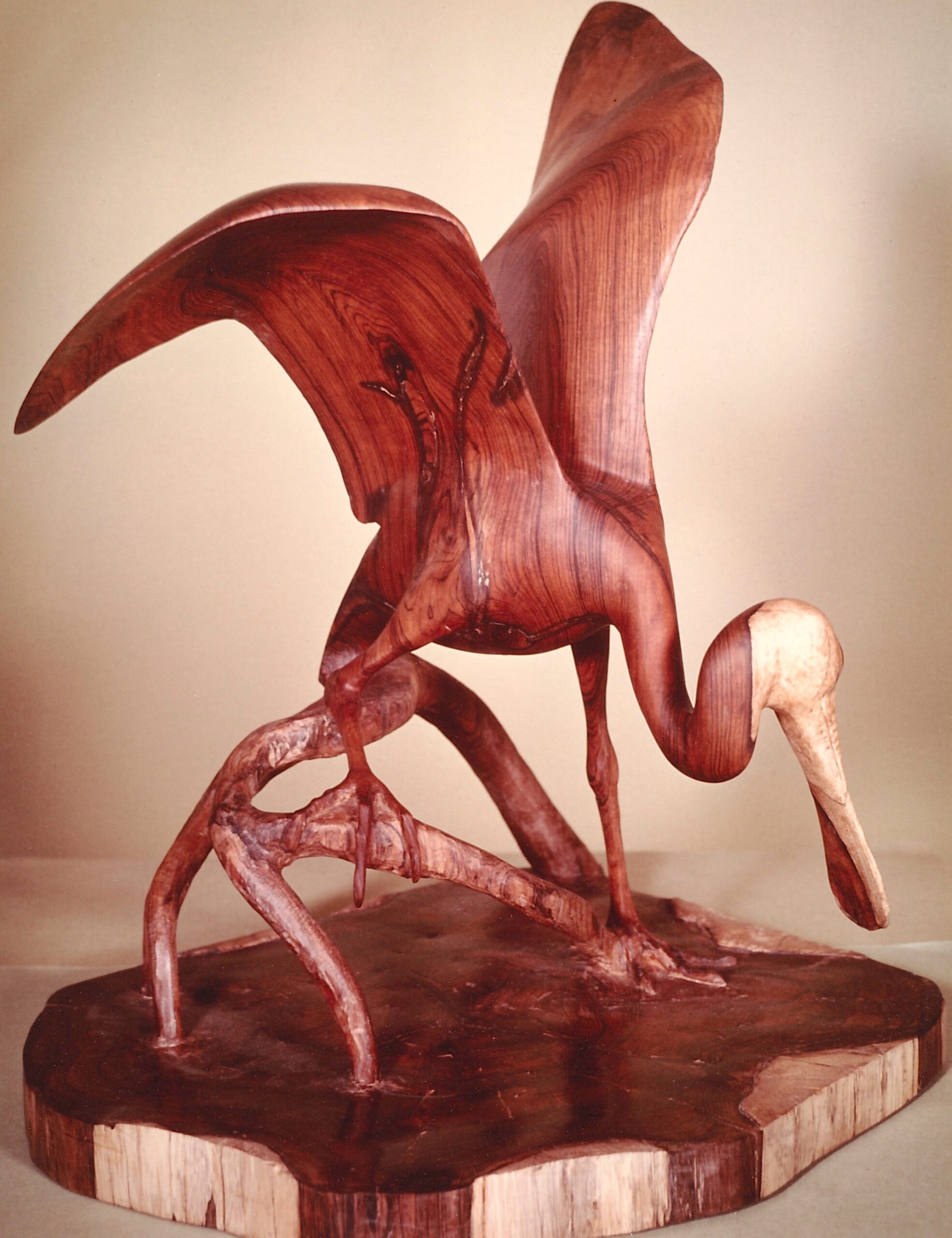
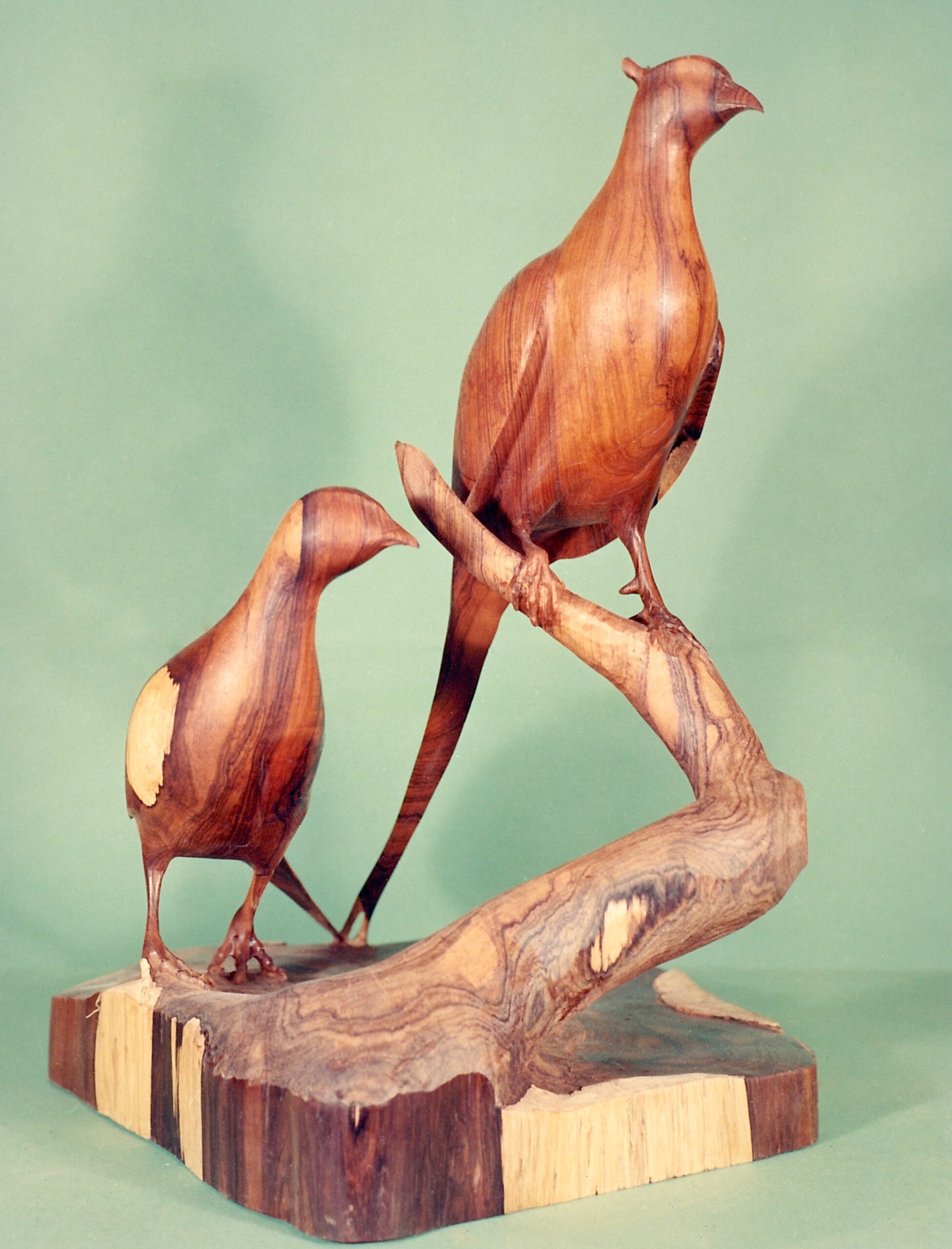
Chippy carefully selected woods with color and grain matching the birds colors. Brazilian Rosewood was used for Pheasants, Partridge and Roseate Spoonbill. By the 1970 Chippy had acquired several large Black Walnut logs that he used for large sculptures. Black Walnut was his favorite wood because of its strength, ease to work, and especially its rich dark brown color, and stunning grain patterns.
The quality of Chippy’s design and craftmanship grew over the years so that sculptures created in the 1980s and 1990s are considered his classical sculptures.
He numbered each sculpture, and inscribed the base’s bottom with the date and number. On a corner wall in his workshop, kept a chronological listing on yellow legal paper of the date, number and species of his sculptures – unfortunately, we have not been able to find this important record of his works.
Chippy developed his own artistic style that is unique and easily recognized. Chippy was proud of his accomplishments, and always smiled when discussing his sculptures with others.
He worked alone without frequent contact with other bird artists. He did not appreciate duck decoys as art, or painted landbirds. One of our neighbors at the head of Maquoit Bay was Ed Gamble, a part time artist, who created very stylized drawings and sculpture, to which Chippy commented that he did not care for them.
Chippy was his own salesman and marketing director – he sold his sculptures to close friends going back to his years at St Paul’s and Harvard. I remembered the number of occasions when he chatted about getting a new commission from a friend for a sculpture. The Bill Vaughan family from Hallowell and the Truesdale family from Portland commissioned a number of sculptures – and, Chippy always was happy and chipper to talk about new sculptures he was planning.
Chippy had few exhibitions of his works. In 1993, the Wendell Gilly Museum in Southwest Harbor had a joint exhibition of Chippy Chase and John Sharp. Even at the end of his career and live there was no major exhibition of his sculptures.
Chippy drew upon his major in mathematics at Harvard when design and scaling his sculptures – he was very precise in calculating the scale of sculpture to fit into the size of the wood he selected. Because of his education in math, in the 1960s he would tutor a few friend’s children – I remember Chippy tutoring Nancy Fenton and Stuart Pratt alongside sculpting.
Chippy enjoyed collecting large format art books on world famous bird artists. These books were expensive and Chippy purchased quite a few of them.
In the early 1980s, Dodie designed and had built a modest size garden shed close to the Merepoint home for Chippy to use as a home workshop. Unfortunately, Dodie never lived long enough to see Chippy using this building. I remember visiting Chippy in the late-1990s when he was in poor health sitting in this shed with his oxygen mask and the door closed pinching the oxygen tube going to the house – Chippy survived.
A Very Social Lifestyle
Chippy regularly attended his class reunions at St. Paul’s School in Concord, New Hampshire, as well as Harvard’s 1930 class reunions.
Chippy had a regular stream of friends visiting him at his Montsweag Road workshop. If they were at his workshop around lunch time, Chippy would usually suggest they join him for lunch at the New Meadows Inn in West Bath.
Chippy had a very close relationship Bill Vaughan and family from Hallowell. Chippy credits Bill for stimulating him to carve his first bird, a partridge, when he was teaching at St Paul’s School in New Hampshire. Bill was a student, and carved a partridge and showed it to Chippy, who thought and said, “I can carve a better partridge than that one.” And, thus began Chippy’s bird sculpting career. Bill and Margaret Vaughan had four children, and during the 1960s Bill and Margaret and the four children would visit the Montsweag workshop. And place an order for a sculpture for one of the children. Chippy would always comment , with a smile, about the Vaughan’s visits. Bill was a pilot, and shared stories with Chippy. Chippy and Dodie invited Bill and Margaret to join them on their “honeymoon” vacation to Kenya. Chippy, Dodie, Bill and Margaret would often tell us tales from their trip to Africa. D.D. and I lived in Hallowell for 30 years, and knew Bill, Margaret and several of their children, and often heard stories of their African safari trip.
Chippy also became life long friends with Herb and Pat Pratt. When Chippy went to the Boston area, he would often stay at the Pratt’s home in Cambridge. The Pratts owned three of Chippy’s sculptures. Chippy, Herb and Pat shared a mutual interest in birds and art. Herb’s twin brother, Davis, had a keen interest in art-photography, and was curator of photography at Harvard’s Fogg Art Museum. Pat was a gifted watercolor painter, and a niece of Boston art connoisseur Deman Waldo Ross who had made major donations of his art collection to the Fogg Museum and Museum of Fine Art. Birds and art were frequent topics of discussion.
Chippy’s dress code reflected his upbring in Boston and Harvard – coat and tie for work in his Montsweag Road workshop. His favorite dress coat was a tan corduroy that he always wore and over the years became spotted with glue marks and lumps of dried glue. Chippy was consistent in his dress. For outdoors wear, Chippy favorite was a tan L.L. Bean jacket.
Chippy’s business model for selling his sculptures were directly tried with his extensive social connections. He was always telling friends of his plants for future sculptures, or when friends mentioned their favorite birds, he would comment on the sculpture options for this species. Many of these connections developed into commissions.
During one springtime birding around Brunswick with Burt Whitman, Chippy suggested a quick visit with Spike, president of Bowdoin College) and Martha Coles – Chippy found them at home in the backyard reading the Sunday New York Times, and Chippy and Burt were quickly engaged in discussion of their birding observations.
Vicki Crandell’s Maine Summer Theater, held at Bowdoin College’s Pickard Theater was one of the summer treats for Chippy where he had front row seats. Occasionally, Chippy would host summertime dinner parties at the Merepoint home for Vicki and her crew – fun times.
Chippy had an annual calendar of events that he quickly established in the 1960s:
Winter
- Christmas Bird Count around Brunswick
- Brunswick Staking Club during winter
- Explorers Club meeting in New York City
Spring
-In March, as the sun grew stronger Chippy would lie down on the workshop’s door entrance, put blinders on, and face the sun – tanning his face
-Birding around Merrymeeting Bay
Smelt fishing in Miller’s Creek
Counting Woodcock flights in March
Springtime migration birding in May
Big Day Birding end of May to see as many species of birds I one day
Summer
– St Paul’s and Harvard class reunions
-Blue Fishing in Casco Bay
– Brunswick Summer Theater
– Attending Camp Chewonki’s summer evening programs around a fire telling stories
Autumn
-Later in 1980s and 1990s, “Birds in Art”
– Joining Steve Etnier taking his large motor yacht to Florida on intercoastal canal
Harvard football games
Chippy’s nephew, Jack Churchill, described him as “gregarious.” Chippy was always smiling and happy. He was always very pleasant and outgoing. He introduced you to his friends and often made helpful contacts and arrangements.
With respect to wood carvings and sculptures, he would encourage and make helpful suggestions. But, he would not become a teacher or critic making strong criticism of one’s artwork.
He was view as a Maine character who was well known for his artwork of bird sculptures. Because of his small size, well-tanned face, and large ears, Chippy was easily recognized. As I recall whenever I was with Chippy, he would encounter someone he knew.
Annually, Chippy kept in touch with his circle of friends through his Christmas cards. Chippy would mention that he signed his Christmas Cards with note at his desk in his workshop close the woodstove during cold December days – two or three days, or more. Friends who received his cards would save them.
Montsweag Road was a corridor of friends with whom Chippy socialized with. When Chippy owned nearby Oak Island, a June 3rd birthday party was a traditional celebration with the Cooks and Wiggins from Murphy’s Corner.
Chippy introduced me to many of his friends. Bucky Fuller’s younger sister Rosie in 1972 invited me and D.D. to spend Memorial Day weekend on Bear Island in Penobscot Bay. When Bucky Fuller spoke at Bowdoin College, Chippy hosted him, and after Bucky’s presentation. Chippy took Bucky and a group of students to a hole in the wall pizza joint to eat and have a beer. Chippy commented, that Bucky talked so much he never had time to eat.
During trips to visit my mother at her home on Merepoint, I would often stop in to see if Chippy was home. During these quick visits I got to meet and know his brother-in-law Tazwell Carrington (Chippy’s first wife, Betty, Tazwell’s sister). Often, when I would visit Chippy at his Merepoint home, when we went inside, he would point out the painting of this first wife betty in the corner of the dining room.
Chippy was a talker, and when I visited he always had a story of his recent activities; however, as I recalled he never talked about WWII or politics.
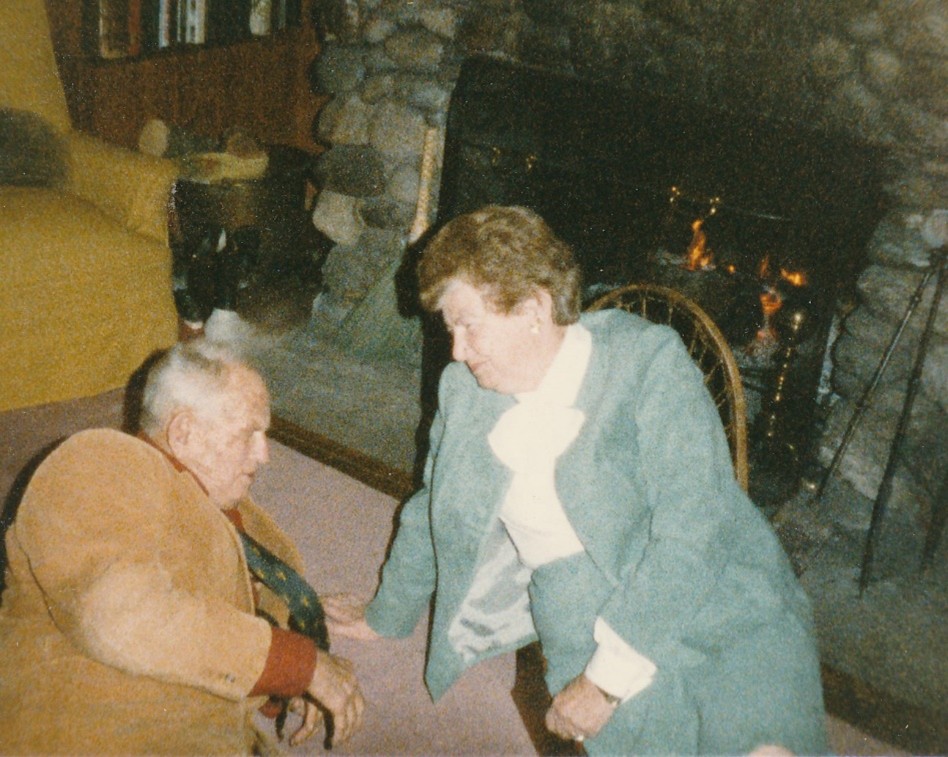
Chippy’s sister Judy had fun times together as shown in the photo of Chippy and Judy on the floor in front of the fireplace at the Whitman’s living room.
Travels
Chippy was a born traveler and adventurer. His parents spent a year traveling the world during their honeymoon. Chippy’s mother’s father was a ship’s captain, and she was born in Liverpool. In 1930, (I am not sure if it was 1939 or1931), Chippy mother arranged for Chippy to crew on the sailing schooner, “Bowdoin” to the arctic. Chippy often talked about this experience, and said “mother just paid Captain MacMillan $1,000 and I became a crew member.”
Chippy joined the New York based Explorers Club, and I recall him talking about recent meeting in NYC that he attended whetting his interest in global travel.
In the early 1960s Chippy was quick to join Maine Audubon Society’s birding trip to Iceland. In the mid- 1960s he went on a safari to Kenya. I recall that Chippy was very excited because I drove him in his green Jeep to the Portland Airport. For the rest of his life Chippy traveled extensively for birding and visiting new countries, He always had stories of his birding travels to tell.
In the early 1980s, on a trip to Asia, Chippy hired bird artist and guide Karen Phillipps as a guide when in Hong Kong. Karen had a pleasing and dynamic personality, and she and Chippy became lifelong friends and correspondents. Chippy commissioned Karen to paint Blue Magpies. Chippy with a smile, would always tell you about his most recent letter from Karen.
Flying
Chippy enjoyed flying his little piper-cub. After WWI a number of his friends became pilots and owned their own airplanes: Bill Vaughan, Steve Etnier and Bucky Fuller. In the late 1940s and early 1950s Chippy was part owner and operator of the Brunswick Flying Service
I think that in the mid to late 1950s Chippy gave up flying, although I remember that he commented about his annual medical check up to keep his aviation license. I never flew with him as a pilot. Although, he always talked about his flying experiences and how much he loved flying. Chippy’s brother-in-law Herb Pratt, once commented after a flight with Chippy, “well, Chippy got us back safely.” Chippy was always telling stories of his days as a pilot and how much he loved flying. By the time I knew Chippy in the 1960s he had sold his airplane, and I never had an opportunity to fly with him in a small plane.
1980s and 1990s
Chippy as a strong person and always working hard at his sculpture. He never thought about retiring because sculpting birds was his life and he was enjoying himself. In 1986, his wife Dodie died of cancer. Chippy began a new life as a widower. In 1988, he celebrated his 80th birthday, and continued sculpting birds, and during this period a number of classic Chippy Chase sculptures.
During this period. I was juried into “Birds in Art” a number of times, and shared many wonderful times and moments with Chippy with bird artists from around the world. Chippy knew many of the artists from past exhibitions, and would introduce me to them. Chippy always spent time with Roger Tory Peterson, and enjoyed retelling stories about Camp Chewonki. “Birds in Art” was a major annual highlight event for Chippy. He was smiling and happy when he attended his last “Birds in Art” exhibition in 1997. While in a wheel chair and in declining health he was still smiling and happily socializing with his fellow bird artists.
Last Years
Chippy added a codicil to his will, leaving his tools and our joint inventory of wood to me. Chippy’s son Chuck honored this directive, and during the summer of 1998 I stopped by the Merepoint home to pick up the chisels, wood, books, and a painting by Karen Phillips that Chippy commissioned that I later donated to the Leigh Yawkey Woodson Art Museum.
Chippy was a very strong minded person; he did what he wanted to do without asking permission; he just did it; and he selected his own friends – I am glad that I was one of them.
Chippy’s History
In 2021-2024, I collaborated with Nancy Fenton, of North Reading, Massachusetts, who grew up in Brunswick in the 1960s, on writing Chippy’s history. Many of my comments in this statement are incorporated into this history. My aunt Bibbo Whitman was from a Brunswick family of many generations, and insisted on spelling Merepoint as it was originally. was originally.
My approach in writing this statement was to highlight Chippy’s character by recalling what he did and his interests and friends, rather than writing descriptions.
In this statement, I have added more background information about conditions and settings in Brunswick, West Bath, Woolwich and Wiscasset to give more details about factors affecting Chippy’s life. Someone would say that his life was “one big happy family between tragedies.”
Sculptures
#342 Black Vulture Black Walnut), 1984
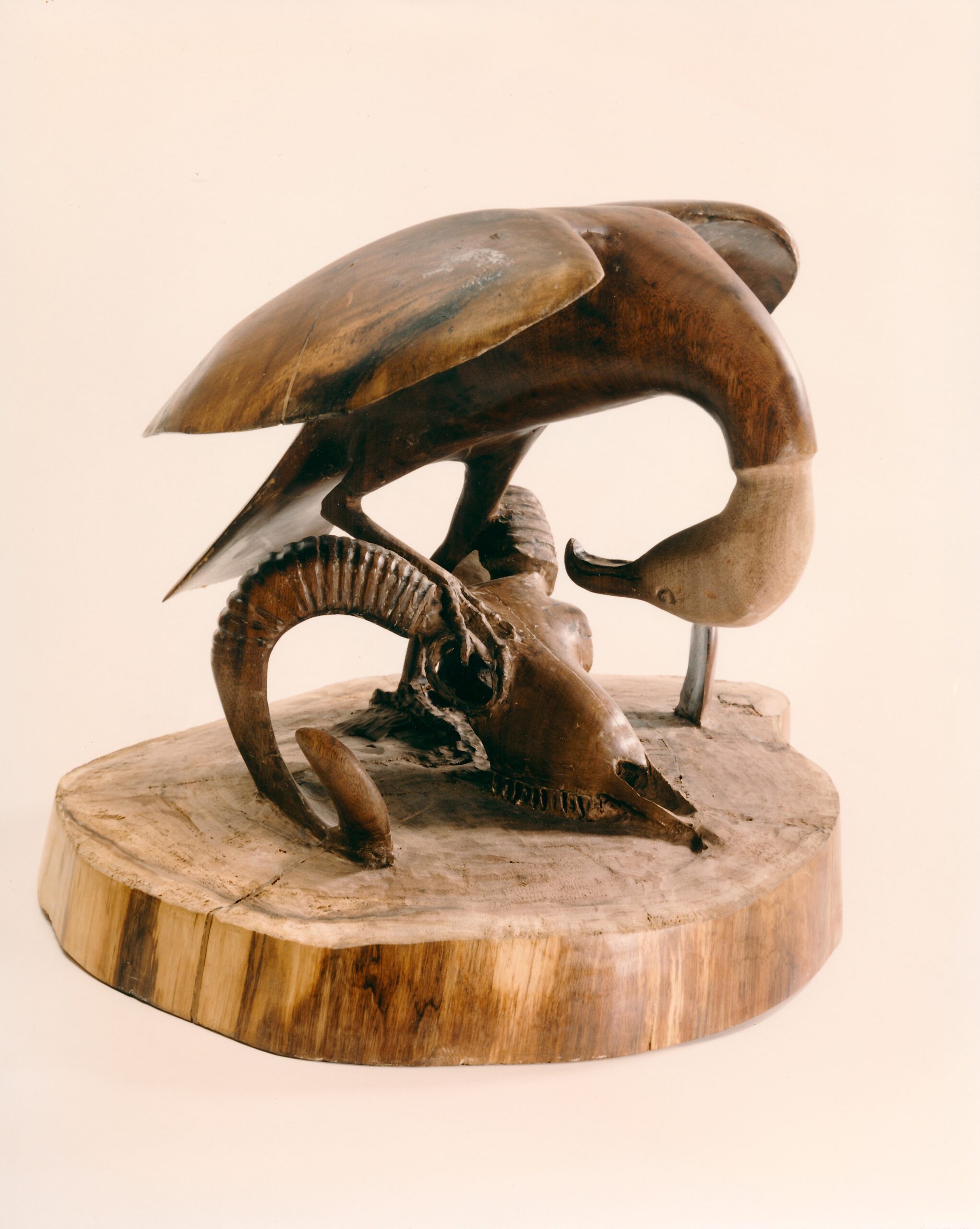
#224 Leach's Petrel pair, Ebony, 1961 (1)
#238 Roseate Spoonbill, Rosewood, 1964
#244 Ruffed Grouse, Rosewood, 1966
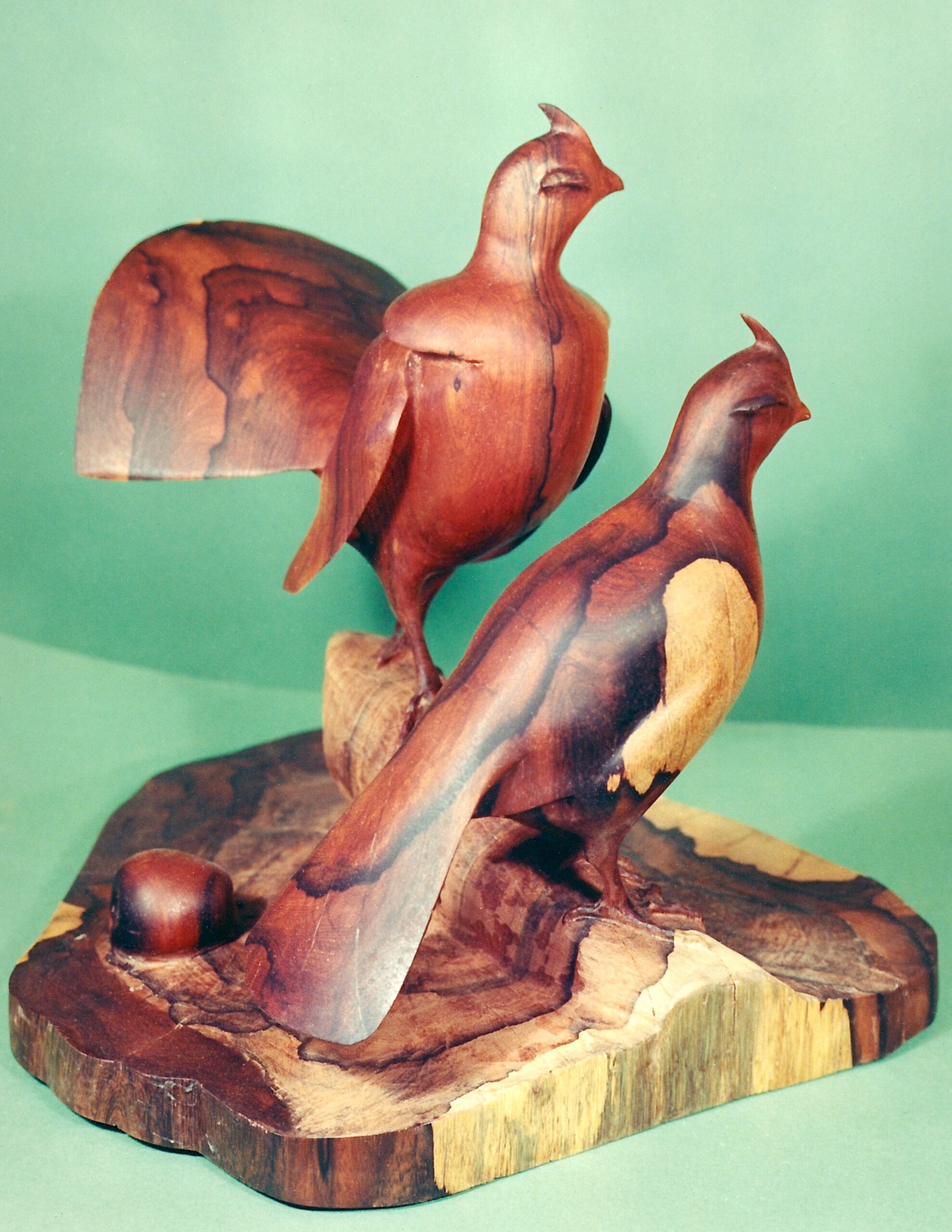
#245 Pheasant Pair, Rosewood, 1966
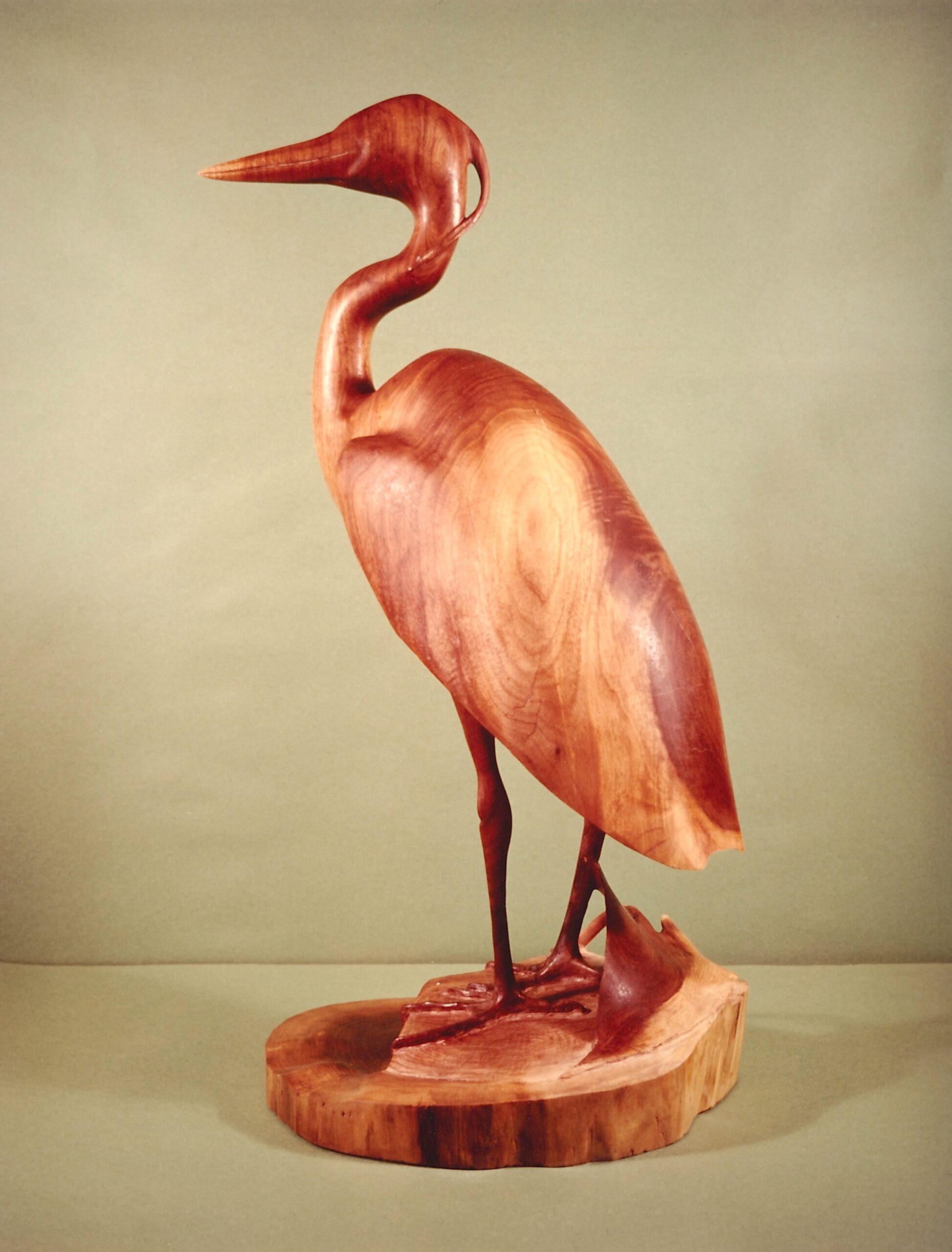
#246 Great Blue Heron, Black, Walnut, 1966
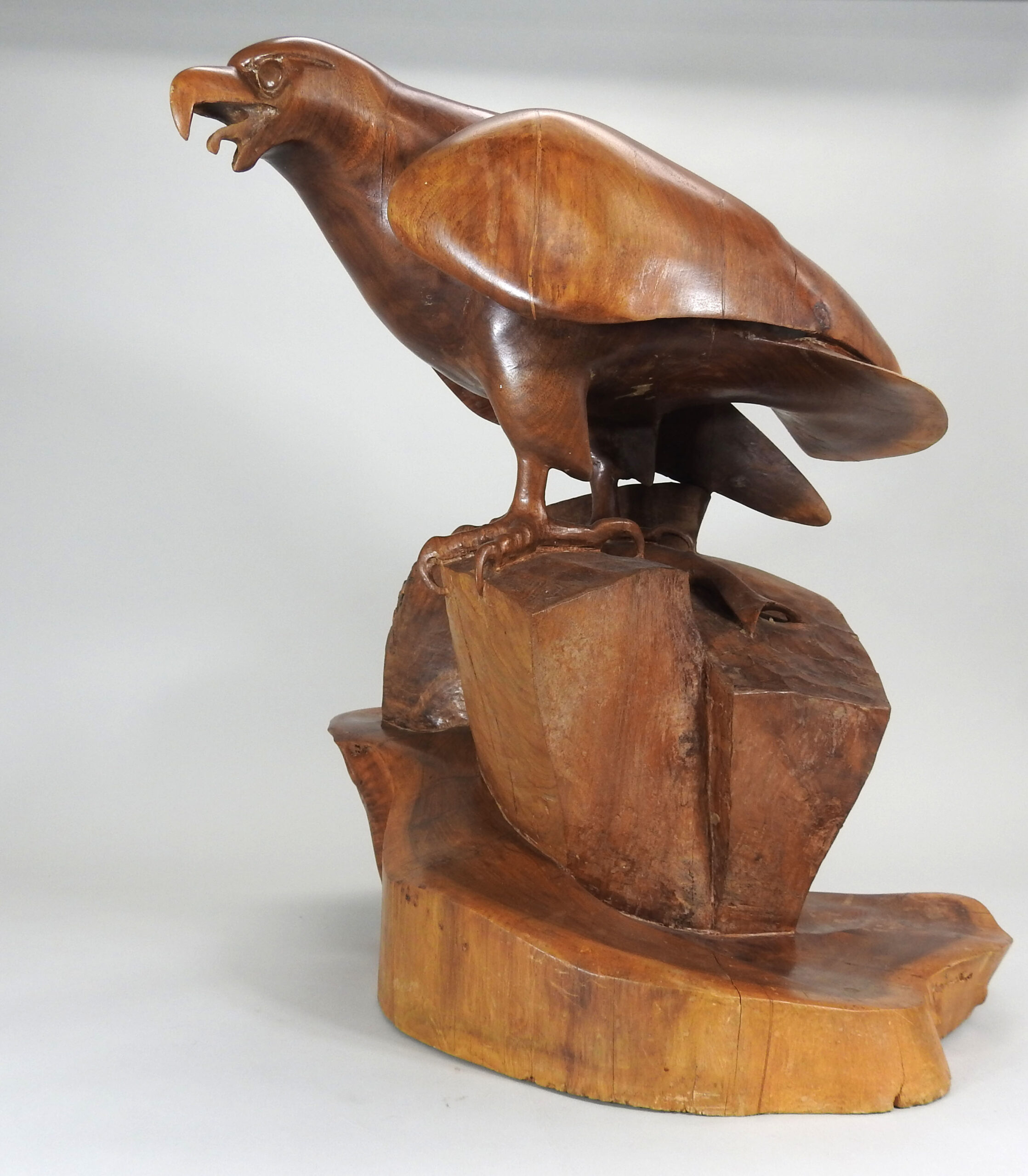
#271 Am. Bald Eagle, Black Walnut, 1970
#312 Oystercatcher, Black Walnut,
#322 Scarlot Ibises , Buninga, 1979